When choosing coco mats for growing microgreens, size and thickness are not the only factors to consider. Another important difference is how the coconut fibres are held together: Is the mat bonded with latex, or is it completely binder-free?
Over the past few weeks, we have been testing different versions and sizes of coco mats for our microgreen production. One interesting result from these tests is that, for our application, latex does not appear to be strictly necessary.
This has led us to take a closer look at binder-free coco mats and the advantages and disadvantages of both versions.
Why Is Latex Used in Coco Mats?
Coco mats are made from natural coconut fibres. To create a stable and relatively uniform growing mat, the fibres can be bonded using latex.
This has several practical advantages. The mat maintains its structure, the fibres stay together more effectively, and the surface can be made more uniform.
However, when using coco mats as a growing medium for microgreens, an important question arises:
Do we actually need the additional binder?
Based on our first tests, binder-free coco fibre also appears to work well for our application. This makes the latex-free version particularly interesting for further testing.
[Photo: Close-up comparison of the coco mat surface]
Binder-Free Does Not Automatically Mean Much Cheaper
One thing we learned while discussing production with our manufacturer is that removing the latex does not necessarily result in a significantly cheaper coco mat.
The reason is quite simple.
Without a binder, more coconut fibre may be required to create a uniform and even surface. A binder-free mat may therefore also be slightly thicker than a comparable version with latex on one side.
This means that the calculation is not simply:
No latex = much lower production cost.
Part of the saving from removing the binder can be offset by the additional amount of coconut fibre required.
For larger-scale microgreen production, however, even a small difference in unit cost can become relevant. This is why we are currently comparing both versions carefully.
The Coco Mat Sizes We Are Testing
We are currently working with several different sizes for our microgreen production and future retail projects.
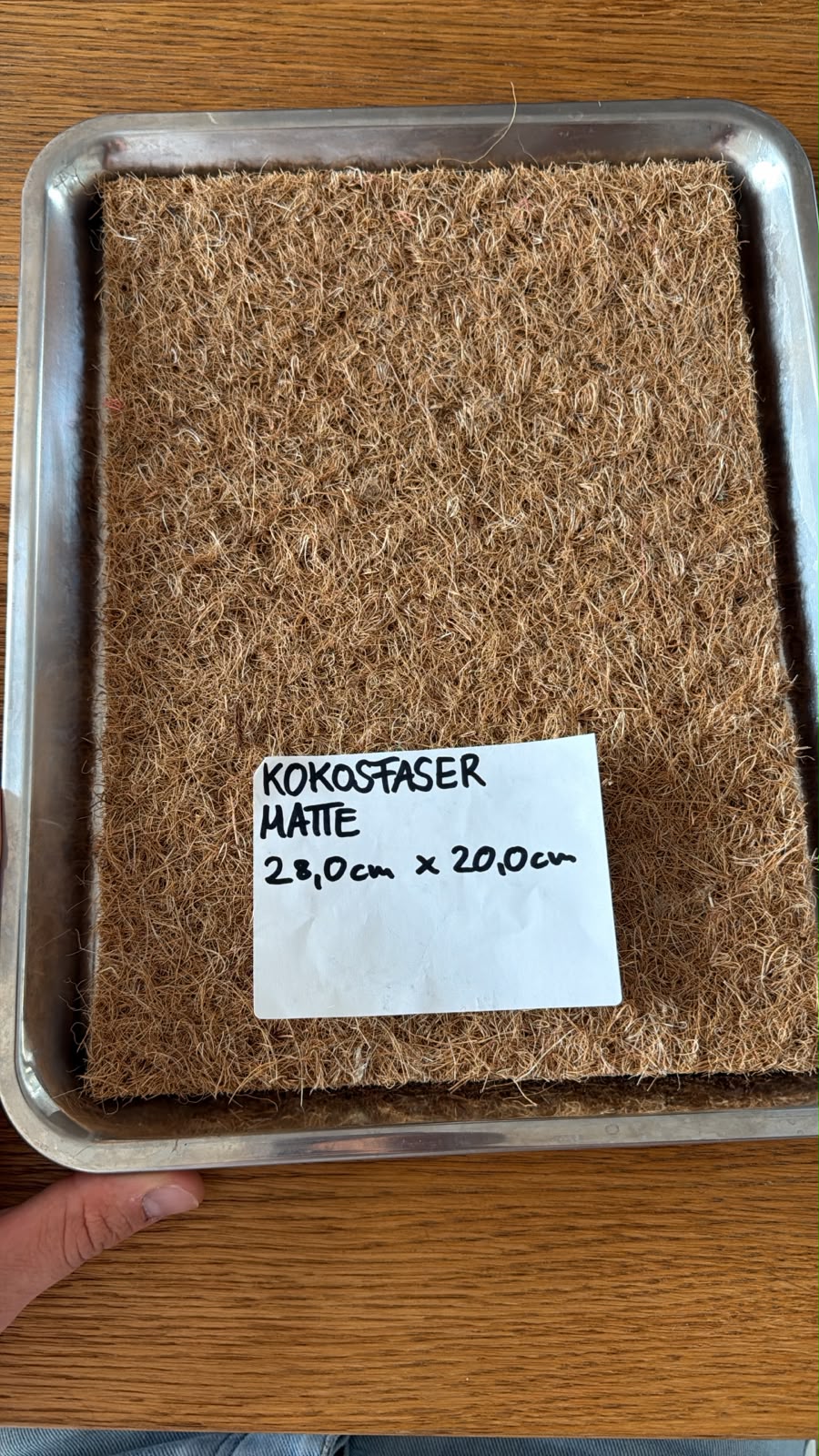
20 × 28 cm Coco Mat
The 20 × 28 cm format is our main full-size growing mat.
Our current consumption is approximately 300 full mats per week, which corresponds to roughly 15,000 mats per year.
We expect this volume to increase as production grows.
At these quantities, purchasing and logistics also become increasingly important. Instead of ordering small quantities frequently, our goal is to keep several thousand mats in stock on pallets and place larger orders approximately every four to six months.
[Photo: Full 20 × 28 cm coco mat]
20 × 14 cm Coco Mat
We also require a smaller 20 × 14 cm format.
Technically, custom rectangular sizes are relatively straightforward to produce because the larger coco sheets can be cut to the required dimensions.
The challenge is production volume.
Custom dimensions generally need to be produced as part of a larger cutting run. For this reason, manufacturers may require several thousand pieces per size.
For professional microgreen growers, this is an important consideration when moving from standard sizes to custom-made growing mats.
[Photo: 20 × 14 cm mat or size comparison]
Small Binder-Free Coco Pads for Retail
Another format we are currently developing is considerably smaller.
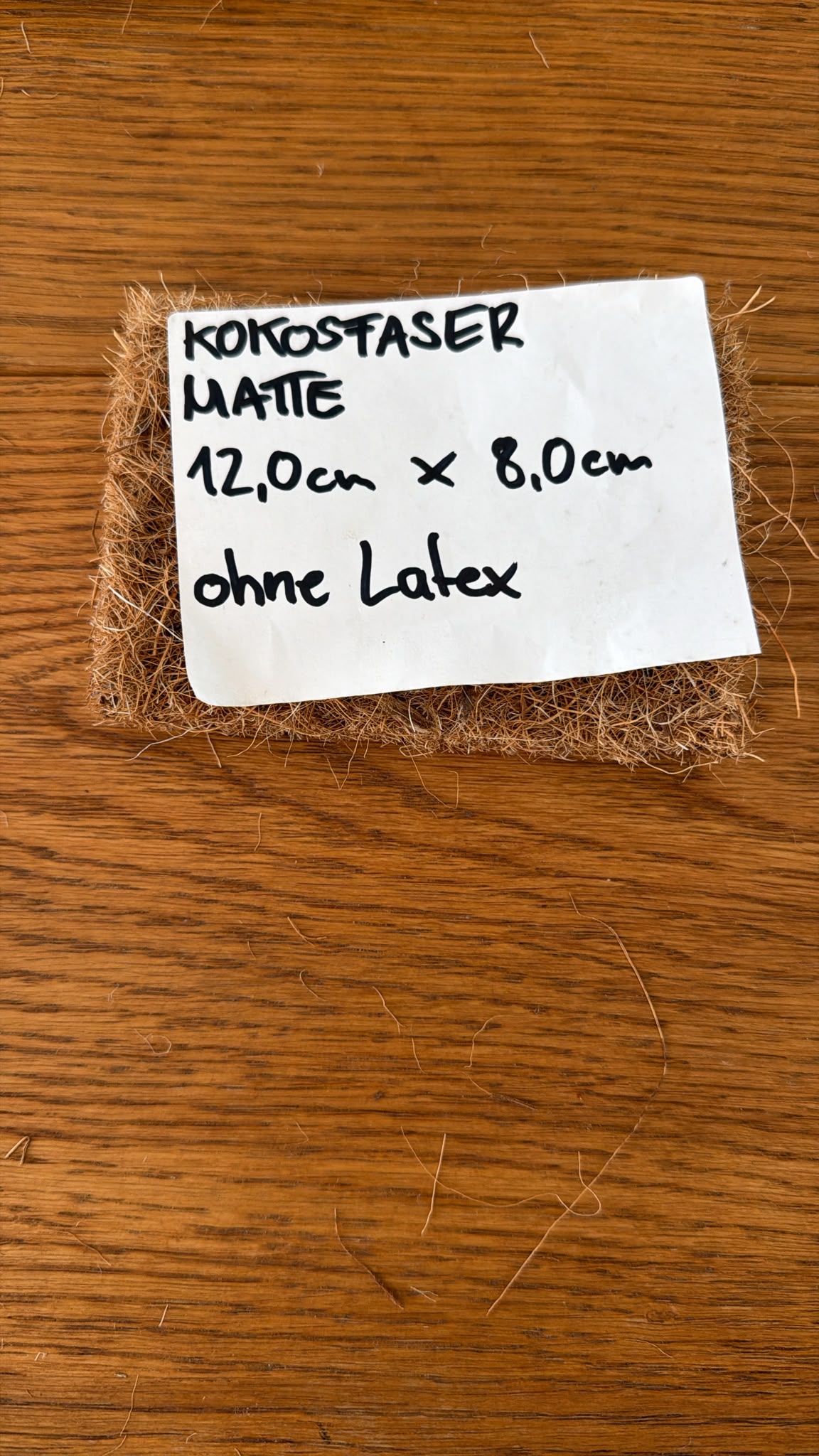
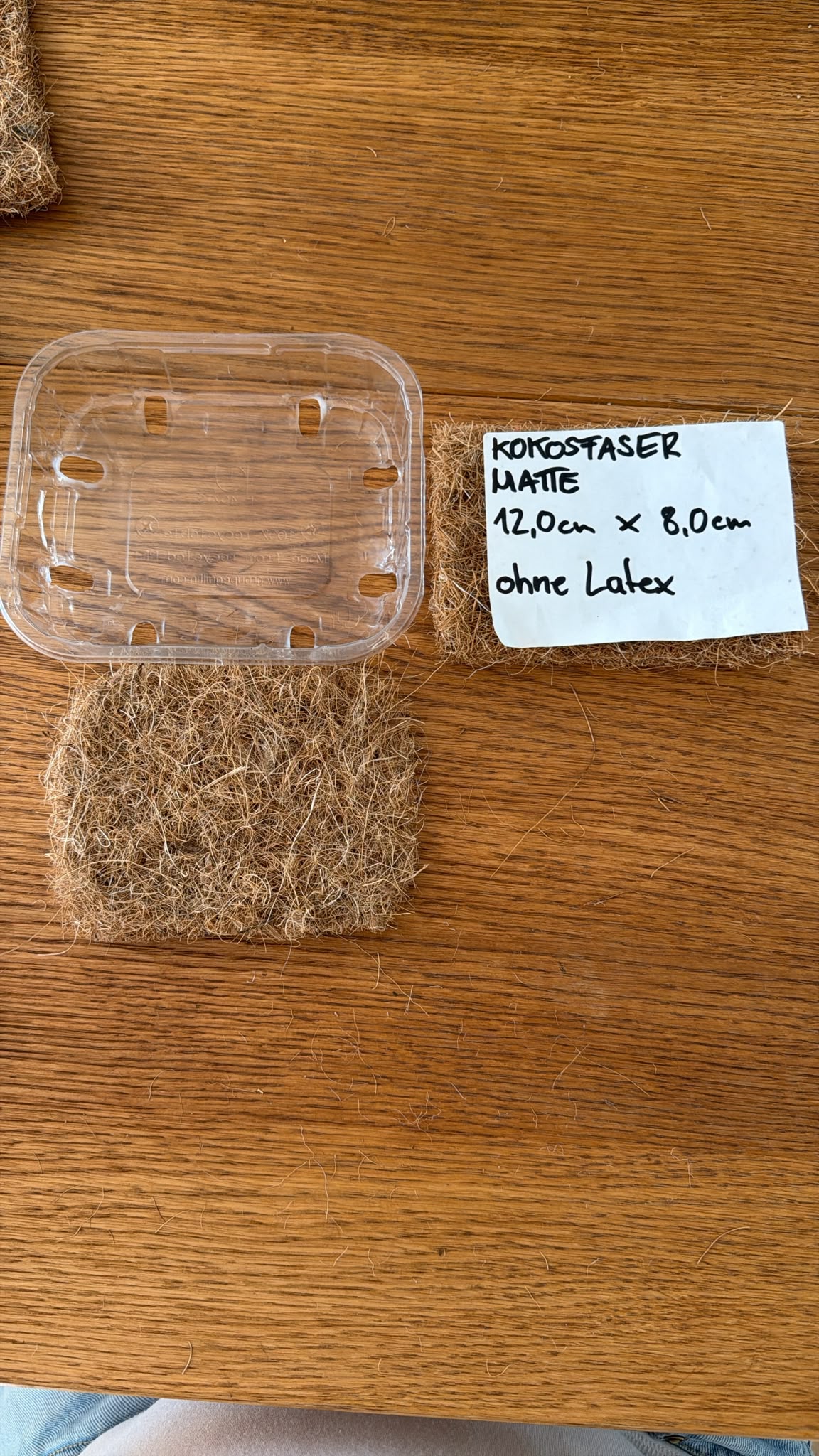
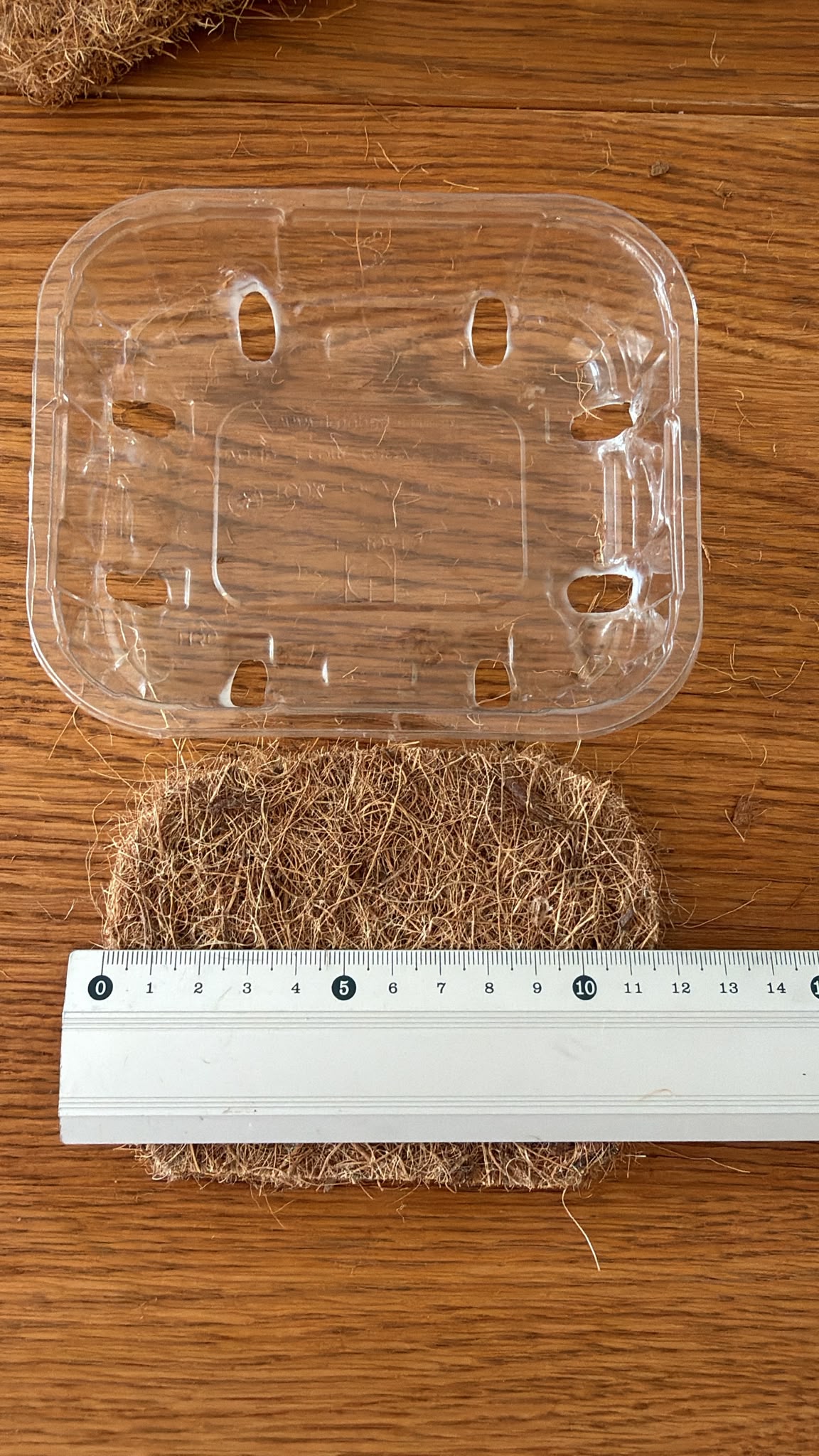
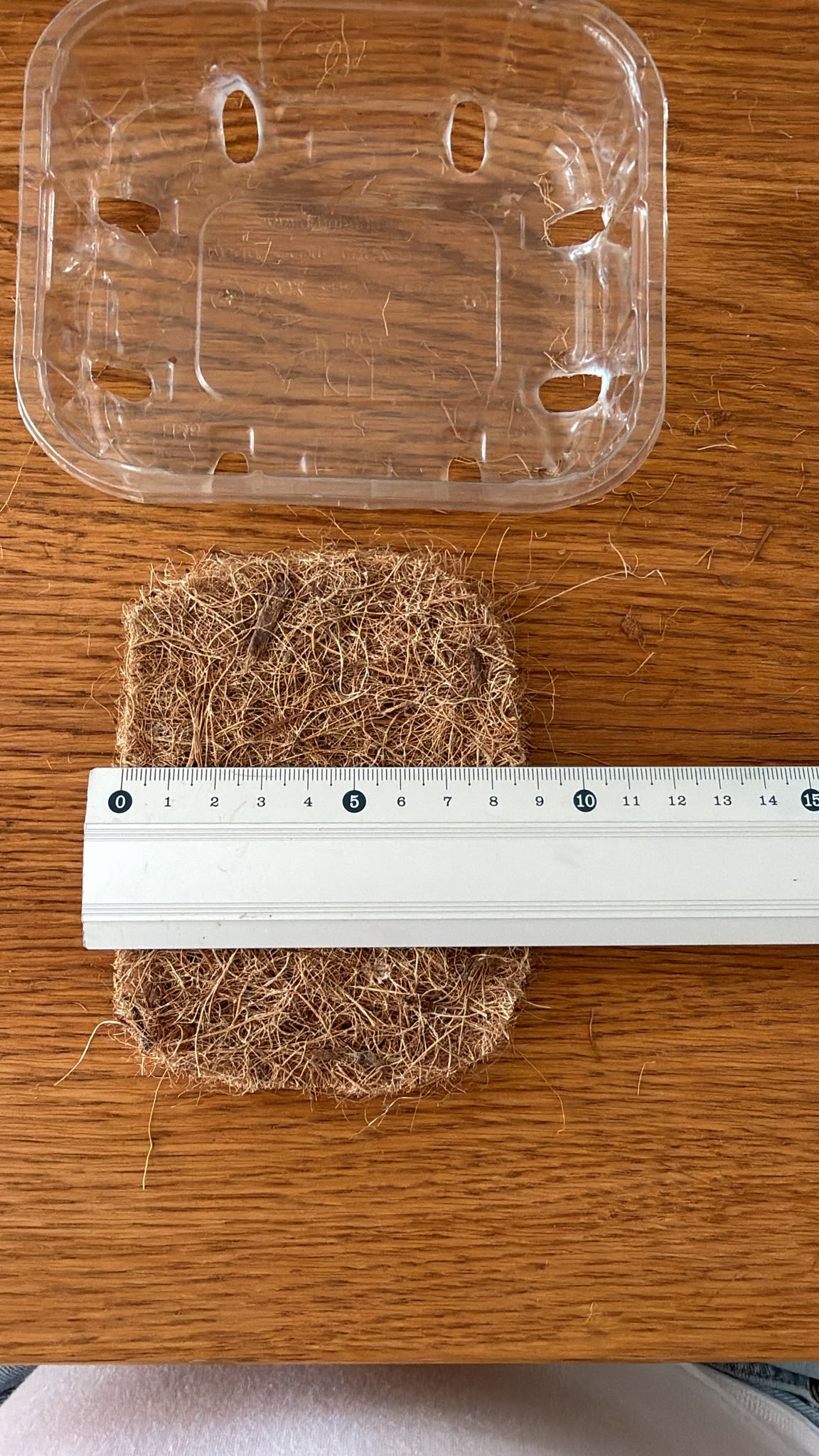
For a planned retail and supermarket project, we initially tested binder-free coco pads measuring 12 × 8 cm.
The material itself was promising, but after testing the dimensions we found that the size was not quite right for our intended application.
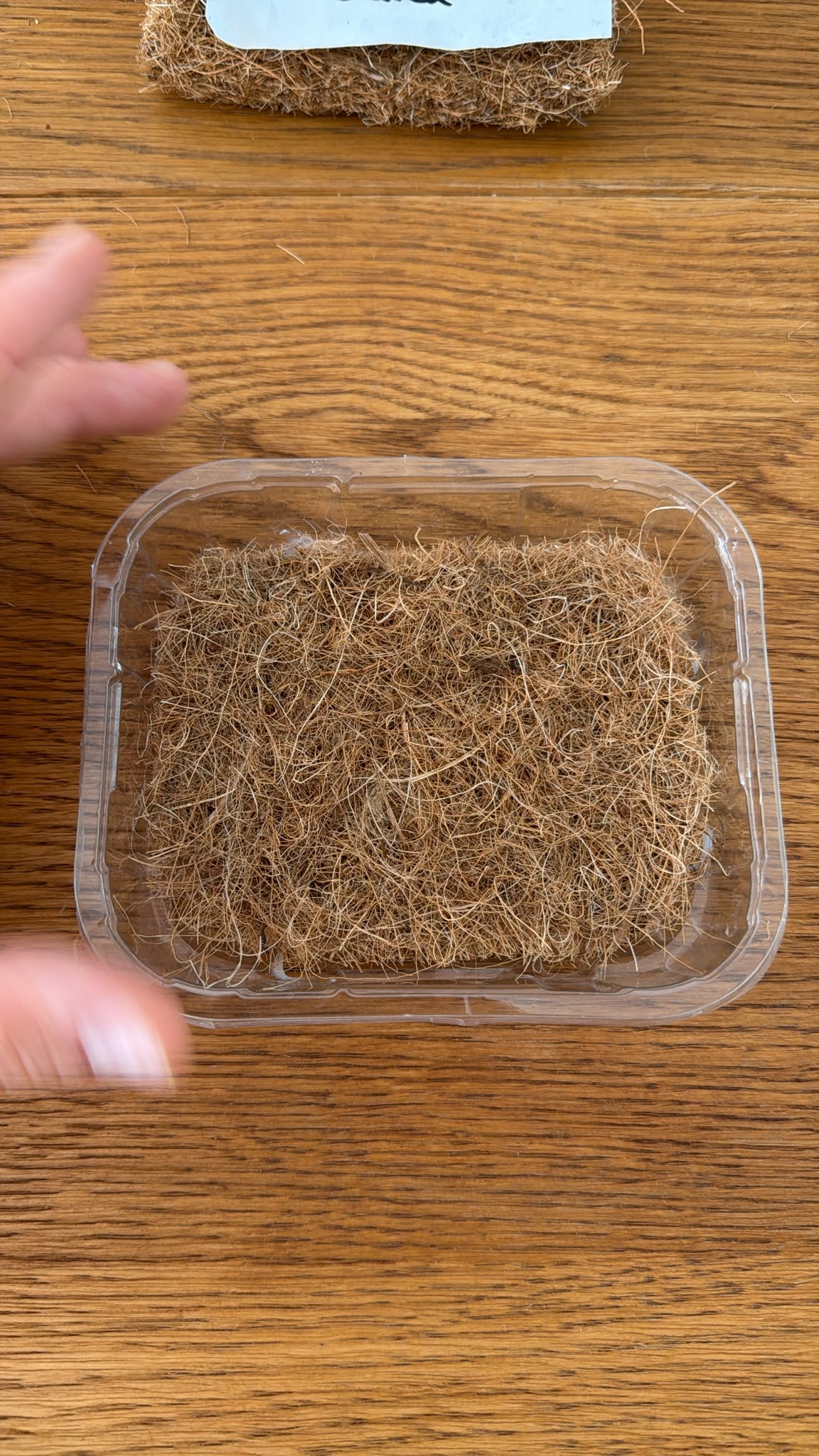
After measuring the container and testing different dimensions, our preferred size is now:
11.5 × 9 cm
[Photo: Measuring the small coco pad]
[Photo: Comparison between the original and required dimensions]
These small pads are particularly interesting for products designed for consumers who want to grow microgreens themselves.
With a small retail growing system, a difference of just a few millimetres can matter. The coco pad needs to fit the container properly while still providing enough growing area for the seeds and root system.
What About Rounded Corners?
For the small coco pads, we also looked into the possibility of having rounded corners.
With the current manufacturing process, this is not practical.
The coco material is cut rather than die-cut with a punch press. Rectangular custom dimensions can therefore be produced relatively easily, while precisely rounded corners would require a different production process or additional tooling.
For our application, this is not a major issue.
Getting the correct dimensions and material properties is much more important than having rounded corners.
Latex vs. Binder-Free: Which Is Better for Microgreens?
There is no simple answer yet.
A latex-bonded coco mat can offer advantages in terms of stability, uniformity and handling. The fibres are held together more firmly, which can make the mat easier to transport, store and use.
A binder-free coco mat, on the other hand, is particularly interesting when the goal is to use the coconut fibre without an additional binding agent.
For us, the practical performance is ultimately more important than the theoretical difference between the two materials.
We therefore want to compare several factors during actual microgreen production:
How well does the mat absorb and distribute water?
Does it remain stable throughout the growing cycle?
How evenly do the microgreens grow?
How well do the roots develop through the coco fibres?
Does the binder-free version require a different thickness or density?
And finally, how significant is the actual price difference when ordering several thousand pieces?
These are the questions that will determine which version makes the most sense for our production.
Custom Coco Mats Become More Interesting at Larger Volumes
One thing has already become clear during this process: custom coco mats become much more interesting once microgreen production reaches a certain scale.
When only a few trays are grown per week, standard mats can be perfectly adequate.
At several hundred mats per week, however, small details begin to matter.
The exact dimensions influence material consumption. Thickness affects handling and water capacity. Packaging affects logistics. And even a very small difference in the price per mat can become significant when multiplied by tens of thousands of pieces.
This is why we are now looking beyond simply finding a coco mat that works.
The goal is to find the right specification for professional microgreen production.
Our Next Steps
We are currently focusing on three main formats:
20 × 28 cm as our full-size growing mat,
20 × 14 cm as a smaller production format,
and 11.5 × 9 cm as a compact coco pad for our planned retail project.
At the same time, we are comparing latex-bonded and binder-free versions.
Our first tests suggest that binder-free coco mats could be a very interesting option for microgreen production. However, we still want to evaluate their stability, thickness, fibre density, water behaviour and overall cost before drawing conclusions.
We will continue testing the different versions in real growing conditions and share what we learn here on microgreen-matten.de.